News Article
Mol, February 11th, 2026
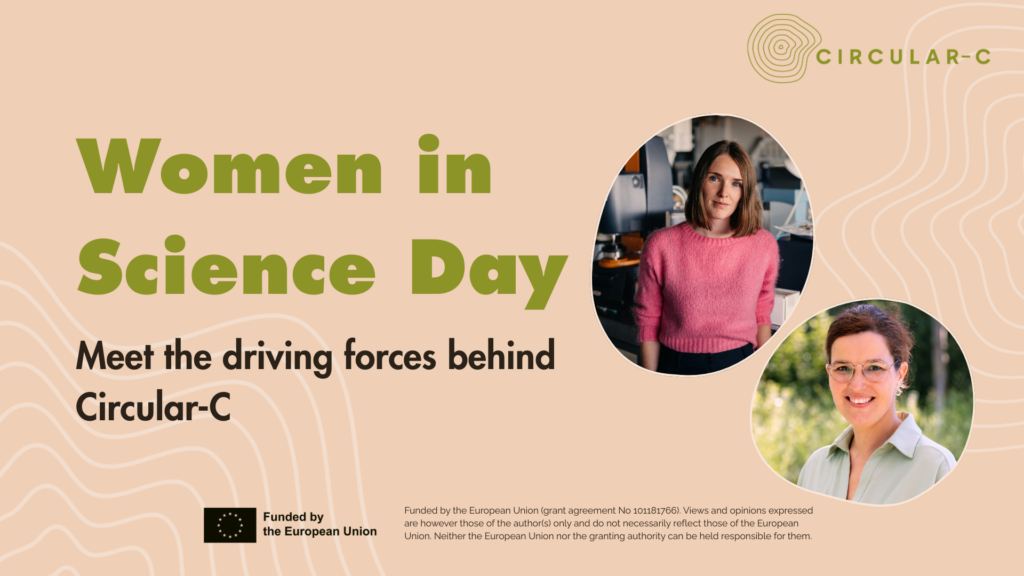
Women in science: spotlight on Circular C’s coordinators Dr. Marlies Thys and Dr. Kelly Servaes
On the International Day of Women and Girls in Science, Circular‑C is proud to highlight two women who embody what this day stands for: scientific excellence, collaboration across disciplines, and the courage to shape more sustainable industries. As coordinators within the Circular‑C project, Dr. Marlies Thys and Dr. Kelly Servaes bring together cutting‑edge research and hands‑on industrial innovation to rethink how we design lignin‑based materials for a circular future.
The aim of Circular-C is to develop safer, more sustainable and more recyclable solutions for Europe’s built environment. The project sets ambitious goals by advancing bio-based adhesives, coatings, and functionalised fibres, as well as digital product passports.
In this context, the leadership of women like Marlies and Kelly is crucial: they not only drive the science, but also shape the culture of collaboration, mentoring, and inclusion that makes such ambitious work possible.
Meet the coordinators
Dr. ir. Marlies Thys – advancing biobased and reversible materials
Dr. ir. Marlies Thys is a researcher at VITO, where she focuses on advancing the development of biobased and/or reversible materials. She holds a master’s degree in Chemical Engineering, with a specialization in Molecular Systems and Materials Chemistry, from Eindhoven University of Technology. She completed her PhD on bioderived adaptive networks through a collaboration between Vrije Universiteit Brussel and VITO, under the supervision of Prof. Niko Van den Brande and Richard Vendamme. After successfully defending her PhD in October 2023, she continued at VITO as a researcher, further building on her expertise in this field.
In Circular‑C, Marlies is responsible for the coordination and development of biobased and reversible lignin‑based adhesives. She helps translate fundamental material science into adhesives that can fit into real industrial applications while remaining aligned with circular design principles.
Dr. ir. Kelly Servaes – connecting lignin research to pilot‑scale reality
Dr. Kelly Servaes obtained her PhD in Chemistry from KU Leuven in 2007. When joining VITO in 2007, she was responsible for the development and application of analytical strategies and techniques for tracking organics in different matrices at VITO. In 2012 she joined the Separation and Conversion Technology unit, focusing on valorisation of biomass through identification, extraction and purification of added‑value components.
In 2014, she joined the bio‑aromatic strategic platform, focusing on development of membrane separation processes for purification and fractionation of lignin‑based streams, issued from pre‑treatment and lignin depolymerisation processes. From the start, she was involved as project coordinator in the establishment of the pilot infrastructure platform of VITO, consisting of the LignoValue Pilot and PILLAR II units, enabling the demonstration of the production of lignin‑based platform chemicals in an industrially relevant environment. Currently, she is project manager of the facility and involved in the day‑to‑day management.
In Circular‑C, Kelly is responsible for the coordination and management of the lignin depolymerization facilities. Her work ensures that the project can test and demonstrate lignin‑based processes beyond the lab, in conditions that reflect industrial reality.
Working together in Circular‑C
How do you share responsibilities in Circular‑C?
Kelly has extensive experience in the coordination of EU projects, including COUNTLESS. She brings this track record into Circular‑C, guiding the coordination and aligning partners around shared goals.
Marlies is gaining hands‑on experience in EU project coordination under Kelly’s guidance. Together, they combine long‑term project leadership experience with fresh scientific perspectives on biobased and reversible materials. This combination of mentorship and co‑creation is at the heart of how Circular‑C is managed.
What are you most looking forward to in Circular‑C?
Marlies: “What we’re most looking forward to is seeing how the expertise and efforts of all the partners really comes together in the end. The goal is to arrive at a final product that is safer, more sustainable, and more recyclable than what is currently on the market. Within the Circular‑C project, this will clearly show how collaboration across the entire value chain can turn circular design principles into concrete, market‑ready solutions with a lower environmental impact.”
Kelly’s work on the lignin depolymerization facilities directly supports this vision: by enabling robust pilot‑scale demonstrations, she helps ensure that the innovations developed in Circular‑C are ready to move closer to the market, rather than remaining as promising concepts on paper.
Reflections on being women in science
The International Day of Women and Girls in Science is also a moment to pause and reflect: what does it mean to navigate scientific careers as women, and what would today’s role models tell their younger selves?
Looking back, what do you wish you had known earlier about being a woman in science?
Marlies: “Looking back, I would have liked to know earlier that uncertainty and self‑doubt are a normal part of starting out in science, and that they don’t reflect a lack of ability. As a student and newcomer, I often felt I had to prove myself more, or wait until I was completely sure before speaking up. What I know now is that learning happens by asking questions and being visible, not by being perfect.”
Kelly: “I also wish I had realized sooner how important it is to build a support network and to seek out environments where diverse perspectives are genuinely valued. Being a woman in science is not a limitation; it’s a strength, and science is better when those perspectives are present and heard.”
These reflections underline themes that many women in STEM recognize: the pressure to be perfect, the tendency to hold back until we are “sure enough,” and the transformative effect of supportive networks and environments. By sharing these insights openly, Marlies and Kelly help make it a little easier for the next generation to speak up, take space, and see their perspective as an asset.
Why stories like these matter
On Women in Science Day, we celebrate more than just individual achievements. It’s also about making those achievements visible, demonstrating their concrete impact, and showing future scientists that they belong in these spaces.
Their journey, from the uncertainties of their early careers to coordinating EU projects and managing pilot infrastructures, illustrates how expertise grows over time, often through supportive partnerships that bring together experience and fresh perspectives.
On this Women in Science Day, we celebrate women like Kelly and Marlies whose work drives circular innovation forward.
Let’s continue to make women in science recognized, heard, and empowered to lead!