
News Article
Olen, June 19th, 2026
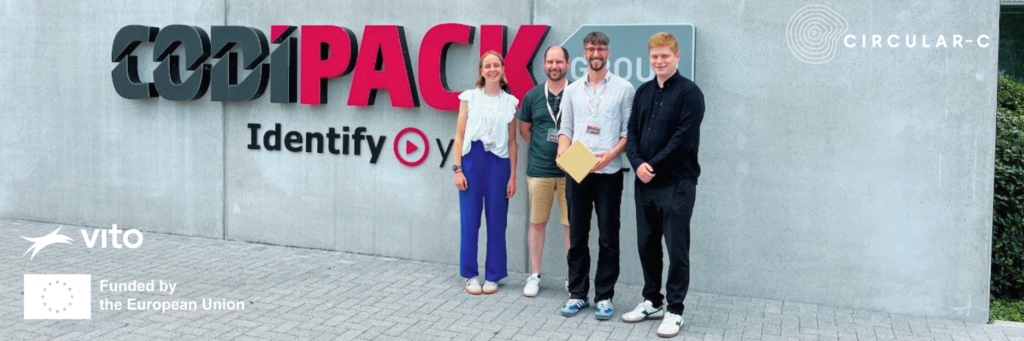
On Friday 19 June, project partner VITO visited Codipack, an international specialist in coding, labelling, and marking systems. The visit marked the kick-off of a joint testing campaign to evaluate current technologies and identify the most suitable method for applying digital product passport (DPP) markers to Circular-C products. This collaboration marks a key step towards introducing DPPs to the construction sector and helping companies prepare for EU Regulation 2024/3110, which took effect on 8 January 2026 and will phase in DPP requirements progressively.
A DPP marker creates an immutable link between a physical product and its digitally stored passport. While numerous marker formats exist with sufficient data-carrying capacity to encode a GS1 Digital Link – a standardized method for product identification – only a few are widely adopted. Among standardized options such as QR codes, Data Matrix, RFID, and NFC, only QR codes and NFC tags can be scanned by virtually any camera-equipped device. This universal accessibility is essential for ensuring that all actors across a product’s lifecycle can retrieve passport information.
The key difference between QR codes and NFC lies in scanning distance: QR codes rely on optical scanning and can be read from a distance, whereas NFC requires the scanning device to be in close proximity to the tag. From a practical standpoint, QR codes offer greater user convenience. For this reason, VITO and Codipack are focusing on QR codes as the preferred DPP marker format.
Several design decisions influence the size and robustness of a QR code. One consideration is data capacity: for Circular-C products, the marker must encode information identifying the product batch. Unique identification at the individual product level is not required, as composition and material properties remain consistent within a batch.
Another factor is scanning distance. The minimum readable distance is typically set at arm’s length – approximately 50 cm – to ensure practical usability on construction sites. Error tolerance is equally important, particularly in the construction sector where markers may be exposed to wear. A higher error tolerance allows more pixels to be damaged before the code becomes unreadable. A tolerance level of around 20% is commonly adopted.
Once the QR code specifications are defined, the next step is selecting an appropriate printing method. Three options are under consideration:
- Laser marking burns the code directly onto the product surface, resulting in the lowest material footprint. However, this method produces limited contrast with the background, which may compromise scannability on certain materials.
- Adhesive labels offer the highest colour contrast and scanning accuracy. Their durability depends on the adhesive bond; trials will assess bio-based adhesives and their resistance to UV radiation, cold, and elevated temperatures.
- Inkjet printing injects ink into the product surface, achieving better contrast than laser marking while being more resistant to wear and tear than adhesive labels.
Over the coming months, VITO together with Codipack will provide valuable insights into how these technologies can be tailored to the specific requirements of construction products, bringing Circular-C one step closer to practical DPP implementation.